
When was the last time you thought about the Amazon rainforest? Maybe you did a project on it in school, maybe you owned a “Save the Rainforest” t-shirt, maybe you have family who live in the region, maybe your business is dependent on crops grown there, or maybe it’s none of the above. Despite being geographically limited to South America, the Amazon is one of the world’s most important natural climate control systems that plays a pivotal role in oxygen production, water cycle and climate regulation, and food security globally—not to mention its crucial role in absorbing heat-trapping carbon from the atmosphere. We all benefit from the Amazon rainforest on a daily basis, but how often do we actually recognize these benefits for what they are?

We mentioned the wildly popular “Save the Rainforest” movement from the 1990s, which drew global attention to the environmental services of the Amazon basin region at large. However, this momentum declined over time. Today, only about $100 – $200 million per year in private philanthropy is invested in Amazon conservation. Initially this might sound like an impressive number, but that quickly changes when you realize that private philanthropy in the United States alone totals hundreds of billions of dollars annually. When viewed in this context, it becomes clear that this critical global resource is chronically under-supported and, at the current rate of damage resulting from deforestation, harm is far outpacing conservation efforts.
In a 2023 article titled, “Why should funding Amazon forest sustainability be the world’s top priority?” authors Jonah Wittkamper, Mariana Senna, and Ricardo Politi of the Amazon Investor Coalition discuss catalytic investment opportunities that could replace ‘deforestation economies’ (economies bolstered by practices that actively harm the rainforest, such as clear cutting for agriculture, logging, etc.) with environmentally and economically beneficial ones such as ecotourism, agroforestry, and silvopasture. The article also identifies carbon markets as a way to support and stimulate local economic activity while activating long-term conservation and sustainability solutions.
To better understand these solutions and their potential impacts on the overall health and wellbeing of the Amazon rainforest (and our planet at large), let’s first break down the current state of local and global affairs in this region.

Choosing the "Right” Economy for the Rainforest
As of 2025, roughly 70% of South America’s gross domestic product (GDP) is produced in regions that directly benefit from the Amazon rainforest. This could mean precipitation and water cycle services, timber, nutrient-rich soils—the list goes on.
However, environmental and economic benefits aren’t limited to just the regions immediately surrounding the rainforest. The Amazon is responsible for 50% of all freshwater runoff that feeds into the Atlantic Ocean, and its overall water cycle is an essential component of the Atlantic Meridionial Overturning Circulation (AMOC)—a long and somewhat hard to pronounce term for the meteorological system that shapes the Gulf Stream and regulates climate throughout the Northern Hemisphere. As a result, the Amazon influences economic activity in numerous nations, from the health and productivity of their agriculture and food systems to fishing, tourism, and more.
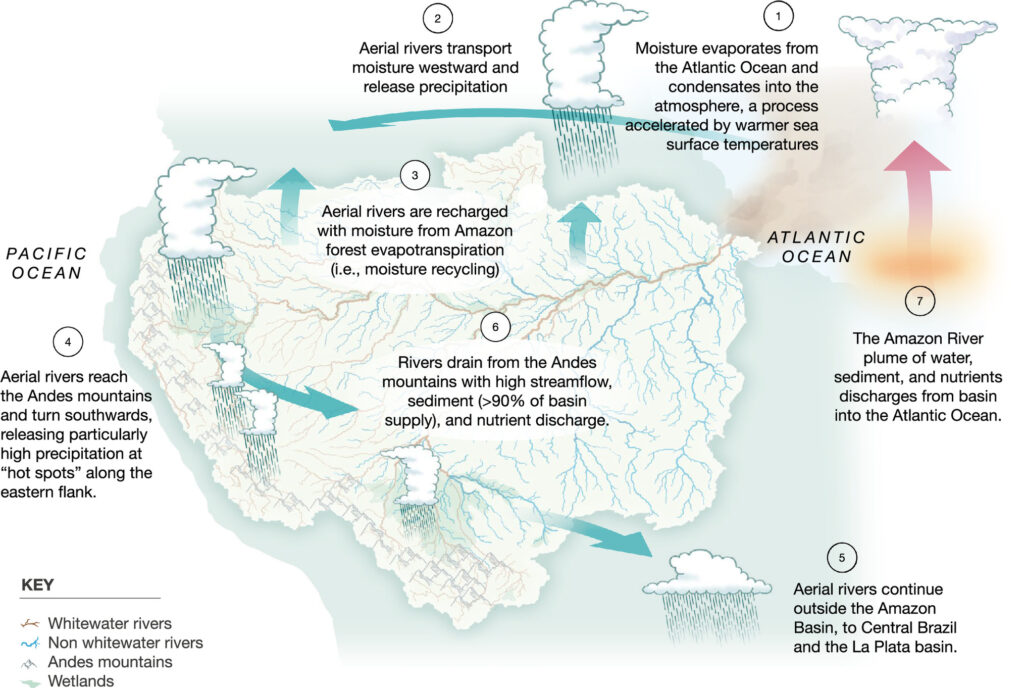
Suffice it to say, the Amazon rainforest is essential to keeping Earth’s climate in balance, and it’s something we can’t afford to lose. Unfortunately, current data suggests we might be uncomfortably close to the tipping point, where damage to the rainforest and its ecosystem services cannot be undone.
By shifting focus from the current economy, which creates wealth by exploiting the rainforest and its resources, to a bioeconomy that sustainably stewards natural resources and promotes a circular (rather than linear) use of goods, we have the opportunity to accelerate support to the people, communities, and practices that will lead to a healthier future—and thriving Amazon—for everyone.
For example, cattle ranchers in the Amazonian region currently utilize approximately 53 million hectares (more than 200,000 square miles) for ranching practices, bringing in roughly $13 billion annually. Based on current carbon market rates, investing in the rehabilitation of these lands—enough to sequester 11 tons of carbon dioxide per hectare per year at an average of $330/ton—can not only improve the environment, but expand the incomes of these ranchers by 35%.
And this is only one example of one industry. The opportunities to make rapid, positive change, for both people and the planet, are immense.
Sustainable Finance in the Bioeconomy
So now we’ve determined the need for sustainable resource management and an economy that supports regenerative practices… but how do we get there? How do we even begin to direct catalytic investments that are fair, equitable, and sustainable?
We start by addressing climate finance.
"Climate finance refers to local, national or transnational financing—drawn from public, private and alternative sources of financing—that seeks to support mitigation and adaptation actions that will address climate change."
United Nations Climate Change
Like many of the bioeconomic solutions we’ve already touched on (ecotourism, agroforestry, silvopasture), climate finance is focused on supporting climate mitigation and community resilience-building by providing the financial infrastructure and support to make these things happen. Climate finance is about aligning our money—where we save it, how we invest it, where we grant it, and what vehicle we use to do so—with our shared core values, including the right to a healthy environment.
Just think for a moment: what does your bank do with the money in your accounts when you’re not touching them? Is your bank investing in climate-smart clean energy, or is it sinking those funds into carbon-heavy markets and businesses? (Since the signing of the Paris agreement in 2015, the 60 largest global banks have invested nearly $7 trillion in fossil fuel projects.) For more information, check out Topo Finance, an EarthShare project all about sustainable finance and management.
“Where money is stored influences how it is invested, what projects are greenlit, and, as a result, how much carbon is emitted. By prioritizing sustainable investments, such as renewable energy, and investing in companies with strong ESG (environmental, social, and governance) standards, we can shift the influence and demand away from fossil fuels and other carbon-heavy markets, industries, and businesses.”
EarthShare
“Infrastructure” is not a particularly exciting word—not on its own, at least. It’s not the topic at the top of the news cycle or the thing keeping you awake at night with anticipation. But we can all agree that it’s important. It is what lays the foundation for the modern world to exist and function. It’s the buildings we live in, the roads we drive on, the cables that keep the lights on and our internet connected. In much the same way, sustainable financial infrastructure is necessary to get money into the hands of the people and communities that need it most, enabling and growing the solutions that accelerate economic and ecological health—not just in the Amazon, but worldwide.
So, what might this look like?
FORMS OF INVESTMENT
Climate finance takes many forms, and not all of them look like traditional donations. How money is distributed to causes and charities can take a number of different shapes outside of a direct donation. Having a diverse array of funding opportunities gives donors and frontline nonprofits alike the flexibility to strategize and remain nimble, meeting the demands of today while also planning for the longer term.
Grants – Monetary awards that come from governments, foundations, corporations, or private citizens in support of environmental and/or climate projects or charities.
Multilateral Funds. Also known as multilateral climate funds, these are funds paid into by multiple nations in order to support global climate mitigation and resilience projects, particularly in the Global South, where countries are disproportionately experiencing the effects of climate change despite contributing to it far less.
Flexible (Concessional) Loans. In order to drive progress, capital must be accessible and affordable. Concessional loans, which offer more favorable terms and interest rates to the borrower, help to get sustainable development projects off the ground while making it far more manageable for the borrower to pay off the debt.
Green Bonds – Functioning in much the same way as a typical government bond, green bonds are a way for citizens to directly support (by ‘buying into’) environmental projects.
Debt / Equity Swaps – Time to trade! Also referred to as a debt-for-nature swap, one government can purchase or waive the debts of another in exchange for environmental commitments, such as land restoration, climate mitigation, or protecting endangered ecosystems.
Guarantees – Guarantees, or project-based guarantees, help reduce the risks associated with private investment in sustainable development. They work a bit like insurance: if a project doesn’t deliver the expected returns right away, the guarantee absorbs some of the loss. Take farmers, for example. Switching to sustainable or regenerative practices often requires expensive upfront changes with no immediate payoff. A guarantee gives them the safety net they need to make those improvements without fearing that a dip in crop yields will bankrupt them.
Getting There Sooner with Intermediaries
Intermediaries and grantmakers help build the necessary financial infrastructure to facilitate the delivery of money to groups supporting nature regeneration and other kinds of climate work throughout the Amazon basin region.
For example, EarthShare and Amazon Investor Coalition, who we referenced earlier, are both intermediaries—providing the tools and insights to help people support the environmental causes and projects they care most about.
Intermediaries help bridge critical funding divides by connecting funders to frontline projects and charities and supporting these connections with specialized services. They address key needs like overcoming language barriers, performing administrative tasks, managing financial records, and producing knowledge to inform grantmaking strategies.
Amazon Investor Coalition’s Amazon Bioeconomy Small Grant Evaluation Facility (ABSGEF) program, which ran from 2023 to 2024, deployed nearly $1 million toward developing forest-positive bioeconomies across the Amazon. Rather than focusing on fundraising, the program connected funders directly to 10 on-the-ground organizations already doing the work.
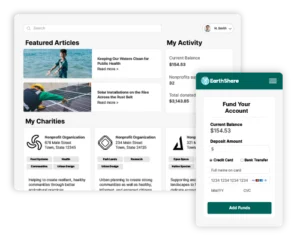
EarthShare is also meeting donors and climate projects where they are by lowering the barrier for entry when it comes to environmental grantmaking and impactful climate solutions. Our Giving Platform allows anyone to open a free donor-advised fund account with no required minimums, so donors—regardless of their tax bracket—can receive an immediate tax benefit when they fund their account while having the flexibility to direct their money to the organizations and causes they care about most. Meanwhile, our fiscal sponsorship program uplifts innovative environmental projects by reducing their administrative burden, so they can focus less on paperwork and more on creating positive change.
With a decades-long history of connecting funders to the environmental charities and causes they are most interested in supporting, we’re making it easier and more accessible for everyone to get involved in the protection and conservation of our shared environment.

Learn More About...
- Protecting Amazon communities and ecosystems from the toxic harms of gold mining.
- How verified carbon credits can help close the forest funding gap.
- Carbon markets in action and how you can better engage with them.
- An investor-led effort to show companies the financial risk of water pollution and encourage large-scale change.
- Reconnecting wildlife corridors throughout the Amazon to conserve endangered species and ecosystems.
- How forest restoration can help us achieve the 30×30 target.
- Ancient Amazonian biochar techniques to improve soil health naturally.
- Confronting the major drivers of deforestation in and around the Amazon rainforest.
- Traditional Indigenous medicine of the Amazon rainforest.
- The Amazonian Platform, which unites local governments and Indigenous nations for the protection of the Ecuadorian Amazon.